
Somerset County Library Employee Handbook
Contents
Section 1: IntroductionSection 2: Workplace Practices
Section 3: About Your Job
Section 4: Communication
Section 5: Compensation
Section 6: Benefits
Section 7: General Work Policies
Section 8: Travel
Section 9: Heat Illness Prevention Plan
Section 10: Separations
Section 11: Corrective Action
Section 12: Grievance Procedures
Section 1: Introduction
1.1 Purpose of this Handbook
This handbook is designed to inform you about working conditions, employee benefits, and the policies affecting your employment. You should read, understand, and comply with all provisions of the handbook. It describes many of your responsibilities as an employee and outlines the programs developed by the Library to benefit employees. The Library’s objective is to provide a work environment that is conducive to both personal and professional growth.
No employee handbook can anticipate every circumstance or question about policy. As the Library continues to grow, we reserve the right to revise, supplement, or rescind any policies or portion of the handbook from time to time as appropriate, with the sole and absolute discretion of the Board of Trustees. Employees will be notified of these changes as they occur by the Library Director.
This handbook supersedes any prior handbook, policy manual, benefits information or practices of the Library and may not be amended or added to without the express written approval of the Board of Trustees.
This manual does not constitute a guarantee that your employment will continue for any specified period of time or end only under certain conditions.
Your suggestions about your work life here are welcome and valued. If you have any questions as to the interpretation or application of a specific section of this handbook or any matter not covered by this handbook, please consult the Director.
1.2 The Library’s Mission Statement
Mission StatementThe Somerset County Library System promotes learning by providing materials, services, and access to information that enrich our community and excite the imagination.
VisionThe Somerset County Library System is every person’s place to explore, learn, dream, and become.
1.3 History of Somerset County Library System
The Somerset County Library System was formed in 1967 when the Princess Anne Public Library and the Lilyan Stratton Corbin Memorial Library in Crisfield joined together under one Board of Library Trustees. Today, the System includes a third branch in Ewell.
The first library in Crisfield was organized about 1910. Its first location was a storeroom and by 1923 it had moved into the newly acquired City Hall. In 1928, Lilyan Stratton Corbin, a native of the Crisfield area and former actress, died in an automobile accident near her New Jersey home. Her husband, Alfred O. Corbin, later visited the city library and was impressed by the valuable service it offered the community. He then selected and purchased a site on East Main Street for a new library as a memorial to his wife.
The Lilyan Stratton Corbin Memorial Library was dedicated in 1930. Designed by Mr. Corbin’s son, John, the building is an excellent example of neo-classical architecture and continues to provide a valuable service to the residents of Crisfield. The present building on Collins Street opened in June 2016.
The Princess Anne Library was housed in the town’s railway station from 1914 until 1959 when Mrs. Katherine Seigler and Mrs. Marie Moore donated a building on East Prince William Street as a memorial to their parents, Charles and Clara Hall Speights. Built in 1860 and expanded in the 1880’s, the building served as the lecture room of the Manokin Presbyterian Church for nearly one hundred years. The present building on Beechwood Street was dedicated in 1988.
The library in Ewell (on Smith Island) is located in the former school, but serves all members of this community.
1.4 Governance
The Board of Library TrusteesThe Library is governed by the Board of Library Trustees, composed of seven members. The Board members are appointed to a five year term and may serve two terms. The Board meets six times a year.
Board meetings are subject to Maryland’s Open Meeting Act outlined in the Maryland General Provisions State Title 3. Employees are welcome to attend Board meetings and may be required to do so by the Director in order to present recommendations or reports. Employees who are not required to attend a Board meeting but would like to do so during their regularly scheduled work hours may request leave.
The powers and duties of the Board are outlined in the Maryland Education Statute 23-405.
The DirectorThe duties of the Director as outlined in the Maryland Education Statute 23-406(f) are as follows:
- Acts as the general executive officer of the Library and is responsible for the management of its operations in accordance with policies approved by the Board of Library Trustees;
- Prepares the annual budget of the Library and presents it to the board for approval;
- Appoints all the Library employees in the system, contingent upon Board approval; and
- Establishes reasonable rules and adopts COMAR for the use of the Library subject to approval by the Board of Library Trustees.
1.5 Relationship to Somerset County Government
The Somerset County Library System is a separate legal entity from Somerset County Government. The Library is governedby the Board of Library Trustees. The Board of County Commissioners appoints Library Trustees and determines the level of county funding that will be provided. The Board of Library Trustees sets all policy and adopts the budget (which includes county, state, and internally generated funding).
1.6 Funding
The Library receives most of its operating monies from the County and State. Additionally, it has augmented its funding via competitive grants which have led to new innovations and improvements.
Section 2: Workplace Practices
2.1 Employee Relations Philosophy
The Board and Director of the Somerset County Library System recognize that its staff is its most valuable resource. Correspondingly, the Library strives to provide a working environment that nurtures and encourages staff members to grow both personally and professionally. The Library has an open door policy that encourages staff to provide suggestions regarding general operations and programs at the Library. However, it must be understood that the Library must always take into consideration the good of the Library, its programs, its patrons, other staff members, and the precedent set when making any decision.
The Library believes in providing work conditions, wages, and benefits to its employees that are competitive with those offered by other employers in this area. If you have concerns about work conditions or compensation, we encourage you to discuss your concerns with your supervisor.
When employees deal openly and directly with supervisors, the work environment can be positive and communications can be clear. The Library demonstrates its commitment to you as its employees by responding to your concerns.
Supervisors and employees are also strongly encouraged to discuss job performance and goals on an informal, day-to-day basis.
2.2 Employee Conduct and Work Rules
To ensure orderly operations and provide the best possible work environment, the Library expects you to follow rules of conduct and abide by the policies and procedures that are outlined in this handbook. This protects the interests and safety of all employees, customers, and the physical property.
The Library expects you to provide excellent service to patrons and maintain quality service at all times. You are expected to be – within reason - proactive in handling patrons’ problems and concerns, and to keep your supervisor informed of any and all key issues.
In addition to the guidelines outlined in this handbook, you are expected to use your best judgment with your co-workers, customers,and visitors while keeping the interests of the Library in mind.
Employees will follow the Library’s Service Standards:
- Focuses on the Customer: Consistently demonstrates awareness that our customers enable us to thrive as a business. Listens to and understands customers’ needs and uses that knowledge to anticipate problems and provide better service than the customer expects; treats co-workers with the same high level of service as external customers; looks for new opportunities to enhance customer satisfaction. For additional information, see the Library Bill of Rights included in the Appendix.
- Takes Initiative: Acts quickly and independently when the situation demands it; sees a need and takes appropriate action without being prompted or reminded; proactively recommends process improvements or solutions to problems. Accomplishes this within the framework of Somerset County Library System policies and guidelines.
- Contributes to a positive work environment: Works as a productive member of a team; treats others with respect and dignity; discourages negativity in the workplace; expresses concerns in a constructive way; demonstrates commitment to organizational goals; supports creative proposals for doing things a better way; helps others to embrace change.
- Uses Strategic Thinking: Understands the mission of organization; realizes how their job function impacts the operation of the organization; supports the organization by demonstrating flexibility, adjusts to changing job demands, deals creatively with challenges or problems.
- Pursues Personal Development: Committed to personal learning; actively seeks opportunities for learning and self-development; requests feedback and welcomes advice when it’s offered; alters behavior to reflect new insights and changing circumstances. Demonstrates personal commitment for delivering high quality expertise to customers.
- Continuous Improvement: Seeks new and better ways to do their job; identifies ways to make improvements to processes and procedures to add value to the organization.
2.3 Chain of Command
The chain of command denotes the line of authority and responsibility that runs through the hierarchical structure of the Library. It is the channel through which information and decision making authority flow throughout the Library. When an employee has a question or an issue that needs to be addressed, employees must first go to their direct supervisor, unless the issue relates to the supervisor. If your direct supervisor is unable to provide an appropriate response or address the issue, then both the supervisor and employee may go to the next level of supervisor.
For emergency and other significant situations in the absence of key personnel, the chain of command for the Library is as follows:
- Library Services Managers
- Assistant Director
- Library Director
- Board of Library Trustees
2.4 Equal Employment Opportunity Statement
In order to provide equal employment and advancement opportunities to all individuals, employment decisions at the Library will be based on merit, qualifications, and abilities. The Library does not discriminate in employment opportunities or practices, based on a person’s actual or perceived status as an individual with disability or based on military or marital status, race, color, religion, sex, sexual orientation, gender identity, ancestry or national origin, age, or any other characteristic protected by federal, state or local law (“protected status”). The preceding applies to the protected status of an individual with whom an employee or applicant associates.
This policy governs all aspects of employment, including selection, job assignment, compensation, corrective action, termination, and access to benefits and training.
If you have any questions or concerns about discrimination in the workplace you are encouraged to bring these issues to the attention of your immediate supervisor or the Director. You can raise concerns and make reports without fear of reprisal. Employees found engaging in unlawful discrimination will be subject to corrective action, up to and including termination of employment.
2.5 Americans With Disabilities Act (ADA)
The Library is committed to complying fully with the Americans with Disabilities Act (ADA) and ensuring equal opportunity in employment for qualified persons with disabilities. All employment practices and activities are conducted on a non-discriminatory basis.
Hiring procedures provide persons with disabilities meaningful employment opportunities. Pre-employment inquiries are made only regarding an applicant's ability to perform the essential functions of the position with or without reasonable accommodation. Reasonable accommodation is available to all individuals with a disability.
Qualified individuals with disabilities are entitled to equal pay and other forms of compensation (or changes in compensation), job assignments, classifications, organizational structures, position descriptions, and promotions.
The Library does not discriminate based on the individual’s relationship to a disabled person.
This policy is neither exhaustive nor exclusive. The Library is committed to taking actions necessary to ensure equal employment opportunity for persons with disabilities in accordance with the ADA and all other applicable federal, state, and local laws.
Reasonable Accommodation for Disabilities Due to Pregnancy
If you incur a disability as a result of or contributed to by pregnancy you have the right to request a reasonable accommodation that may include:
- changing your job duties;
- changing your work hours;
- relocating your work area;
- providing mechanical or electrical aids;
- transferring you to a less strenuous or less hazardous position; or
- providing leave; and
- does not impose an undue hardship upon the Library.
You may be required to provide medical certification of the need for reasonable accommodation to the same extent a certification is required for other temporary disabilities. Such certification shall include:
- the date the reasonable accommodation became medically advisable;
- the probable duration of the reasonable accommodation; and
- an explanatory statement as to the medical advisability of the reasonable accommodation.
Company policies and practices regarding the availability of leave, the accrual of seniority and other benefits and privileges, reinstatement, and payment under any health or temporary disability insurance or sick leave plan, formal or informal, shall be applied to disability due to pregnancy or childbirth on the same terms and conditions as they are applied to other temporary disabilities.
2.6 Harassment/Sexual Harassment
It is the policy and practice of the Library to maintain and foster a work environment in which all employees are treated with decency and respect. Accordingly, the Library has adopted a zero-tolerance policy toward discrimination and all forms of unlawful harassment, including but not limited to sexual harassment, as well as actions, words, jokes, or comments based on an individual's status as protected veterans or individuals with disabilities or based on protected status will not be tolerated.
This zero-tolerance policy means that no form of unlawful discriminatory or harassing conduct towards any co-worker, contractor, patron, or any other person in the workplace, will be tolerated. The Library is committed to enforcing its policy at all levels, and any employee who engages in prohibited discrimination or harassment will be subject to discipline, up to and including immediate discharge from employment for a first offense.
Sexual harassment is defined as unwelcome or unwanted sexual conduct, requests for sexual favors, and verbal, nonverbal, or physical conduct of a sexual nature that creates an intimidating, hostile or offensive work environment. Such harassment is demeaning to another person, undermines the integrity of the employment relationship, and is strictly prohibited.
Any incident or situation that you believe involves illegal discrimination or harassment of a sexual nature or otherwise because of the above described characteristics, by a co-worker, a supervisor or third parties on our premises over whom we have control, should be reported to your supervisor immediately for investigation and any corrective action that the Library deems appropriate. If the complaint regards the supervisor, you should immediately contact the Director. If the complaint regards the Director, you should immediately contact the Board of Trustees.
We encourage the reporting of all perceived incidents of sexual and other harassment. Anyone who retaliates against an employee who reports harassment or participates in a related investigation will be subject to corrective action. Employees can raise concerns and make reports without fear of reprisal.
Any supervisor who becomes aware of possible sexual or other unlawful harassment must promptly advise the Director, who will handle the matter in a timely manner and as confidentially as possible.
2.7 Hostile Work Environment
Creation of a hostile work environment, such as severe and pervasive conduct that permeates the work environment and interferes with an employee’s ability to perform his or her job, will be treated as a form of harassment.
2.8 Pregnancy Discrimination
Under Maryland law, disabilities caused or contributed to by pregnancy are treated as temporary disabilities for all job-related purposes, including under any health or temporary disability or sick leave plan. Policies and practices will be applied to any disability due to pregnancy on the same terms and conditions as they are applied as to other temporary disabilities.
If an employee requests a transfer to a less strenuous or less hazardous position as a reasonable accommodation, the employer must transfer the employee for a period of time up to the duration of the employee’s pregnancy if the same conditions are met as with any other temporary disability.
2.9 Employee Medical Information
Information regarding an employee’s health condition will be kept personal and confidential. Information related to an employee’s medical status may only be shared on a “need to know” basis, and employees should not share or discuss another employee’s medical status beyond that “need to know” basis. The Library will comply with all applicable statutes and regulations that protect the privacy of persons who have a medical condition.
2.10 Drug Free and Alcohol Free Workplace
It is the Library’s desire to provide a safe, healthy, and productive workplace. The Library is also committed to ensuring that its reputation and image are not compromised in any way. To promote these goals, employees cannot report to work under the influence of illegal drugs, the illegal use of prescribed drugs or alcohol and must remain in fit condition to perform all assigned duties. This policy does not apply to an employee’s use of a prescribed drug when used as prescribed and that does not pose a threat to the employee’s or others.
While on the Library premises and while conducting business-related activities off the Library premises, no employee may use, possess, distribute, sell, or be under the influence of illegal drugs, the illegal use of prescribed drugs or alcohol.
Violations of this policy may lead to corrective action, up to and including immediate termination of employment, and/or required participation in a substance abuse rehabilitation or treatment program.
Alcohol or Drug Testing:The Library may require alcohol or drug testing when:
- A reasonable suspicion exists that you are under the influence of any controlled substance, drug or alcohol while on the job, in the workplace or representing the Library; or
- When an accident, near-miss, or incident occurs in which safety precautions are violated or careless acts are performed, and a reasonable suspicion exists that you are under the influence.
Testing will be conducted at a qualified laboratory. Test results will be kept as confidential as possible. A positive test result is grounds for corrective action up to and including termination.
Refusal to submit to testing when a reasonable suspicion has been established may result in corrective action up to and including termination.
If you have questions or concerns about substance dependency or abuse, or this policy you are encouraged to discuss these matters with your supervisor or the Director to receive assistance or referrals to appropriate resources in the community without fear of reprisal.
Under the Drug-Free Workplace Act, an employee who performs work for a government contract or grant must notify the Library of a criminal conviction for drug-related activity occurring in the workplace. The report must be made within five days of the conviction.
2.11 Safety Procedures
The Library provides information to employees about workplace safety issues through regular internal communication channels such as supervisor-employee meetings, e-mail, memos, or other written communications. Information will include potential safety and health hazards and safe work practices and procedures to eliminate or minimize hazards.
Some of the best safety improvement ideas come from employees. Employees with ideas, concerns, or suggestions for improved safety in the workplace are encouraged to raise them with his/her supervisor or the Director. Reports and concerns about workplace safety issues may be made anonymously if the employee wishes. All reports can be made without fear of reprisal.
Everyone is expected to obey safety rules and to exercise caution in all work activities. You must immediately report any unsafe condition to the appropriate supervisor. Anyone who violates safety standards, causes hazardous or dangerous situations, or fails to report or, where appropriate, remedy such situations, may be subject to corrective action, up to and including termination of employment.
In the case of accidents that result in injury, regardless of how insignificant the injury may appear, employees should immediately notify their supervisor. Such reports are necessary to comply with laws and initiate insurance and workers' compensation benefits procedures.
For detailed information about safety and emergency procedures, please reference the SCLS Safety, Emergency, and Disaster Manual.
2.12 Emergency Closings
At times, emergencies such as severe weather, fires, power failures, pandemics, or bomb threats may disrupt the Library’s operations. In extreme cases, these circumstances may require the closing of the Library. At such times, the Director or designee will insure that the Library Board, staff, and local media are notified and that the closure is posted to the Library’s voicemail, website, and social media presences.
In cases where the administration closes the Library, scheduled employees will be paid at their regular rate as administrative leave. Administrative leave from an emergency closing supercedes any regular, daily leave (e.g, vacation or sick leave), and any previously scheduled entries on the employee’s timesheet will be replaced with administrative leave. Administrative leave does not supercede long-term forms of leave, including FMLA and leave without pay.
In cases where an emergency closing is not authorized, anyone who fails to report for work will not be paid for the time off. Employees may request available paid leave time.
The Library will usually follow Somerset County Government emergency closings.
The Director or designee has the authority to make closing decisions on a case-by-case basis.
2.13 Conflict of Interest Policy
This policy applies to board members and staff of the Library. An actual or potential conflict of interest occurs when a board or staff member is in a position to influence a decision that may result in a personal gain for that party, a relative, a business associate, or another organization with which they are affiliated as a result of the Library’s business dealings. For the purposes of this policy, a relative is any person who is related by blood or marriage, or whose relationship with a board or staff member is similar to that of persons who are related by blood or marriage.
No "presumption of guilt" is created by the mere existence of a relationship with outside parties. However, if a board or staff member has any influence on transactions involving purchases, contracts, or leases, it is imperative that they disclose as soon as possible the existence of any actual or potential conflict of interest so that safeguards can be established to protect all parties.
Personal gain may result not only in cases where a board or staff member or relative has a significant ownership in a firm with which the Library does business, but also when a board or staff member or relative receives any kickback, bribe, substantial gift, or special consideration as a result of any transaction or business dealings involving the Library.
Examples may include:
- The Library contracts to purchase or lease goods, services or property from a board or staff member or a relative or business associate of an interested party; or
- A board or staff member or a relative or business associate of a board or staff member is gratuitously provided use of the facilities, property, or services of the Library; or
- A board or staff member seeks to obtain preferential treatment by the Library for themselves, a relative, or business associate; or
- A board or staff member seeks to make use of confidential information obtained from the Library for their own benefit or for the benefit of a relative, business associate, or other organization.
If there is a conflict, staff, including the Director, with a conflict will abstain from participating in discussions surrounding the issue in conflict. Board members with conflicts will abstain from voting or participating in discussions surrounding the issue in conflict.
Staff will report potential conflicts to the Director. Board members will report potential conflicts to the President of the Board and copy the Director. The Director will report potential conflicts to the full Board.
2.14 Nepotism
It is the Library’s policy to hire, promote, and transfer employees on the basis of individual merit and to avoid any hint of favoritism or discrimination in making such decisions. The employment of individuals with close relationships at certain levels of the Library, including Board Members, or in positions where one might have influence over the other’s status or job security is regarded as a potential violation of this policy. Even if favoritism or discrimination is not shown, the existence of the situation may precipitate questions difficult to answer or may cause some discomfort for the individuals involved.
The employment of relatives in the same area may cause serious conflicts and problems with favoritism and employee morale. In addition to claims of partiality in treatment at work, personal conflicts from outside the work environment can be carried into day-to-day working relationships.
Relatives of persons currently employed by the Library may be hired only if they will not be working directly for or supervising a relative. Library employees cannot be transferred into such a reporting relationship. If the relative relationship is established after employment, the Director will decide whom to transfer.
In other cases where a conflict or the potential for conflict arises, even if there is no supervisory relationship involved, the parties may be separated by reassignment or termination from employment.
For the purpose of this policy, the Library defines "relative" as your spouse, parent, child, sibling, domestic partner, child's spouse, parent’s spouse, grandparent or grandchild, or household member.
Section 3: About Your Job
3.1 Definitions of Employment Status
It is the intent of the Library to clarify the definitions of employment classifications so that you understand your right employment status and benefit eligibility.
According to the Fair Labor Standards Act, each employee regardless of category is designated as either non-exempt or exempt from federal and state wage and hour laws.
Non-exempt employees are entitled to overtime compensation under the specific provisions of federal and state laws. Exempt employees are excluded from specific provisions of federal and state wage and hour laws. The exempt or non-exempt status of your position is determined by your wage, method of wage payment and actual job duties. Your exempt or non-exempt classification may be changed only upon written notification by the Director.
Full-time Employees: Regularly work 40 hours per week and are entitled to all benefits.
Part-time Employees: Regularly work less than 40 hours per week and receive prorated vacation, sick leave, and holiday benefits. Part-time employees do not receive personal leave or medical, dental, or vision insurance benefits due to plan restrictions. Part-time employees comprise of the bulk of our staff, and in order to fulfill the Library’sservice mission, we rely heavily on our part-time staff to cover weekend and evening hours.
Designated Substitutes: Designated substitutes are former regular employees, generally retirees, who remain associated with the organization, do not have a regular schedule, and may be called upon to fill a shift if needed to maintain the Library’s operational schedule. Because they do not have a regular schedule from which to take leave, designated substitutes receive a 4% premium on wages in lieu of vacation or sick leave.
3.2 Hours of Work
The workweek begins on Sunday and ends on Saturday. The standard workday is 8 hours with a one (1) hour paid lunch break. During a 3 to 4 hour shift, one paid 15 minute break will be granted. During a shift of more than 4 but less than 8 hours, two paid 15 minute breaks will be granted. If a lunch or other break is to be used to come in late or leave early, a request should be filed with the employee’s supervisor in advance.
Your supervisor must approve all hours worked above 40 hours in a work week before they are worked.
Employees who work at the Princess Anne and Crisfield branches will not work exclusively at one branch.Staff may be assigned to either mainland branch to provide programming or other organizational needs. For such assignments, the alternate branch will be considered to be the employee’s regularly scheduled work location.
If an employee is unable to attend a shift at the alternate branch, they should notify both branch managers as early as possible.
3.3 Employment Related Documents
The following documents which may be related to your employment at the Library are available in the workroom area of your branch and can be found on the Google Drive. Please ask your supervisor the location of these documents.
Employee documents:- Timesheet
- Request for Travel Reimbursement
- Request to Attend Training
- Incident Reports
- Workman’s Compensation Forms
Documents relating to changes to your emergency contacts, retirement, direct deposit, withholding, health insurance, etc. can be acquired by asking the Administrative Assistant and should be returned to her.
3.4 Probation Period
The probation period for all new employees is one year from the date of hire.
The Library can extend this period for an additional six months if necessary. Employees may be reassigned during this period. The employee and the Library have the right to terminate employment during this period at any time with or without cause. If you are terminated during the probation period, you may not appeal the termination.
Midway and atthe end of the probationary period, you will undergo a formal written performance appraisal.
After the midway review, keys and alarm codes will be assigned to the employee.
At the end of the period, a decision will be made about granting regular employee status, extending the probationary period, or terminating the employment relationship.
Anyone promoted into a new position may be required to undergo a three (3) month probationary period. If a newly promoted person does not perform satisfactorily during this period, they will be returned to their previous position or a similar position.
Everyone, regardless of classification, status or length of service, is expected to meet and maintain the Library’s standards for job performance and behavior.
3.5 Promotion
When an employee is promoted to a position with a higher level of pay, the rate of pay in the new position will be increased by a percentage to be determined by the Director, or brought to the minimum of the range for the new/promoted position, whichever is higher. The employee may undergo a three (3) month probationary period in the new position during which time they may be placed back into their previous position or a similar position for any reason.
3.6 Demotion
In the event of a demotion, the rate of pay may be adjusted to within the lower position salary range. Demotion may occur for budgetary or operational reasons, as well as for cause.
3.7 Transfers
Transfers can be voluntary or involuntary. In the case of a voluntary transfer, an employee may request a transfer to any department for which they are qualified. If they transfer to a lesser-paid position, the pay of that position will apply. They will enter the class as a probationary employee in Step 1 of the appropriate grade.
For involuntary transfers, any employee may be involuntarily transferred to a position with a pay rate as close as possible to the one previously received. An involuntary transfer may occur for any of the following reasons: technology change, lack of funding, or lack of work.
3.8 Performance Evaluation
Performance evaluations will take place annually. New employees will be evaluated after six months and after one year.Current employees promoted to a new position will be evaluated at the end of their three month probation period.
The Director will review all written performance appraisals before discussion with the employee.
The employee and their supervisor are strongly encouraged to discuss job performance and goals on an informal, day-to-day basis.
3.9 Announcement of Job Vacancies and Hiring Practices
The Library is committed to promotion from within when appropriate. Internal advancement and external competitiveness are both encouraged in recruiting and placing the most qualified person in an open position.
Employees who wish to apply for the open position must submit a letter of interest form in accordance with the vacancy announcement. Employees are also encouraged to discuss their interest in or intention to apply for a posted position with their immediate supervisor.
The Library accepts applications for all positions at any time (you do not need to wait for a vacancy announcement to apply for a job). All applications will be kept on file for six months.
The Library will complete security checks on new employees.
3.10 Ownership of Materials
All information that employees write, develop, receive or compile, including but not limited to emails, publications (publications does not include publications in library or academic related journals or any literary endeavors) , articles, speeches, reports, manuals, etc., during the performance of their duties are the intellectual property of the Library.
3.11 Confidentiality
Employees are required by law to maintain the utmost care in preserving confidential information such as patron information and library records. Everyone must comply with the law governing confidentiality of records and transactions as outlined in the Maryland Education Statute 23-107. Failure to do so may lead to corrective action, up to and including termination.
As a result of the USA Patriot Act, the Library may receive requests for library records including Internet use records. When such requests are made, refer them to the Director immediately.
Law enforcement subpoenas must be referred to the Director. A warrant may be executed immediately. Do not interfere and contact the Director as soon as possible.
Your home address and phone number will be kept in the strictest confidence and will not be given without your express permission and except where required by law.
3.12 Reference Checks
The Library recognizes your right to privacy. Therefore, all requests for information about a current, retired, or terminated employee must be given to the Director or designee, who will confirm only dates of employment, salary rates, and position(s) held.
The Director will release additional information if you complete a release form to authorize the release of additional information. This release form will be filed in your personnel file.
To ensure that individuals who join the Library are well qualified and have a strong potential to be productive and successful, the Library will check the employment references of all applicants.
3.13 Personnel Records
Federal and state law requires the Library to keep certain employee records on file for specific lengths of time. These records are confidentially maintained in your official personnel file by the Administrative Assistant.
Employees may review the contents of their personnel files, by appointment, with the Director or designee. Personnel records are the property of the Library. Employees may not alter, remove, add, or replace any documents in your file. Employees, other than supervisors, may not view the personnel records of any other employee.
To keep these files current, you must inform the Library promptly of any changes in marital status, address, number of dependents, insurance beneficiary, telephone number, and whom to notify in the event of an emergency. Such information is critical to ensure that benefits and health insurance can be administered in an accurate and timely manner.
3.14 Telecommuting
Telecommuting allows employees to work at home for all or part of their regular workweek.
Telecommuting is a work alternative that may be appropriate for some employees and some jobs. It is not an entitlement, and it does not change the terms and conditions of employment.
Either the employee or their supervisor can suggest telecommuting. In order to be eligible for telecommuting, employees must have been employed by the Library for at least one year and have exhibited above average performance.
Employees desiring to telecommute should prepare a written proposal to submit to their supervisor outlining how they can accomplish their task via telecommuting, including the number of days per week they will telecommute. The plan should include objective methods of measuring productivity and the achievement of goals. Any telecommuting arrangement made will be on a trial basis for the first three months and may be discontinued, at will, at any time, at the request of either the telecommuter or the Library.
Telecommuting can be informal, such as working from home for a short-term project, or for employees on personal or medical leave, with the consent of the employee's health care provider, if appropriate. All informal telecommuting arrangements are made on a case-by-case basis, focusing on the business needs of the Library first.
For more information speak with your supervisor or the Director.
3.15 Staff Development and Training
The Library is committed to staff development. To facilitate this process the Library encourages attendance at in-service workshops, continuing education seminars and library conferences.
Many programs are available through the Eastern Shore Regional Library, the Maryland State Library Agency, other Public Libraries, the Maryland Library Association and the American Library Association. Participation is also required to meet Maryland State Department of Education certification requirements foremployees.
Staff may be assigned to participate in development and training activities. The Director must approve attendance in advance. Staff will be paid for up to eight (8) hours per day for attendance at approved meetings. Staff will be compensated for travel time and mileage.
The Library may require mandatory attendance at some trainings.
Staff will carpool whenever possible.
Annual Staff Day
All Library staff are required to attend an annual staff day. Annual Staff Day serves as a way for all staff members of the three branches to convene, hear special presentations, work collaboratively on system wide projects, and ultimately improve service.
Staff Day is typically held on Columbus Day.
3.16 Certification of Staff
The Library Director, Professional Librarians, and Library Associates will be certified by the Maryland State Department of Education pursuant to COMAR Section 14.38.01.01.
Section 4: Communication
4.1 Employee Orientation
All new employees will undergo an orientation to acquaint them with the Library’s policies and procedures, their job, benefits, and internal and external working relationships.
At this time, new employees will also receive an orientation packet that will include the Employee Handbook, Policy Manual, and Orientation Manual.
4.2 Problem Solving Procedures
The Library is committed to providing the best possible working conditions for its employees. Part of this commitment is encouraging an open and frank atmosphere in which any problem, complaint, suggestion, or question receives a timely response from supervisors or relevant others.
The Library strives to ensure fair and honest treatment of all employees. Supervisors and employees are expected to treat each other with mutual respect. Employees are encouraged to offer positive and constructive criticism.
If clarification is needed on established rules of conduct, policies, or practices, employees can express your concern with your supervisor.
Not every problem can be resolved to everyone's total satisfaction, but only through understanding and discussion of mutual problems can employees and management develop confidence in each other.
Employees are encouraged to communicate with each other and keep relevant parties informed of key issues.
See related sections 2.3 and 10.1 of this handbook including chain of command and grievance procedure.
4.3 Staff Meetings
In order to facilitate effective communication across the different locations and ensure the best possible service, the Library holds six staff meetings per year. The Library understands that due to extenuating circumstances or scheduling conflicts employees may not be able to attend all six meetings. As such, employees are required to attend a minimum of three meetings a calendar year. The Library may also require employees to attend training or special staff meetings as needed.
4.4 Phone Calls
Personal CallsEven though it is understood that personal phone calls provide a necessary balance between work and personal life, employees are asked to limit the time used to make personal phone calls while at work so that it does not interfere with work obligations. Employees are expected to make reimbursement arrangements for long distance calls from Library phones.
Cell phone use in public areas while working is prohibited.
Library Business CallsTo ensure effective telephone communications, employees should always use the approved greeting and speak in a courteous and professional manner.
If the person that the caller asks for is unavailable, employees should attempt to transfer them to the person’s voicemail rather than taking a written message.
It is the responsibility of all Library employees to familiarize themselves with information on all services in order to provide accurate information to all who request it.
4.5 Personal and Electronic Mail
Personal MailThe Library’s address should not be given out as a personal address. Letters, packages, etc. may be delivered to the Library for convenience but privacy cannot be assured. Employees are asked to be cautious in what they have delivered to the premises so that deliveries do not compromise the Library’s image or safety.
Electronic MailEmail accounts are to be used mainly for Library business. Employees should limit personal use of emailduring work hours and should never allow personal use to interfere with the Library’s needs.
Employees should check their emailaccount at least once each day that they are on duty.
Library e-mail is a public record and subject to disclosure (Maryland General Provisions Statute Title 4). The Library reserves the right to open and read any emailreceived via its system. Email accounts are archived and deleted at separation from service.
4.6 Internet Use - External Communications:
Somerset County Library strives to use social media in advancing its organizational mission and goals. All official Library presences on social media sites are considered an extension of the organization’s information networks and are governed by the organization’s policies including e-mail, internet usage, and computer policies; this policy applies to all types of online public communications.
Official use by Somerset County Library of social media services is ultimately the responsibility of authorized staff members who are permitted to conduct official Library business using social media sites and tools.
The Library staff is responsible for complying with all applicable federal, state, and county laws, regulations, and policies. This includes adherence to established laws and policies regarding copyright, fair use, records retention, privacy laws and information security policies established by Somerset County Library.
The Library reserves the right to withdraw certain posts and/or remove inappropriate comments that are not consistent with Somerset County Library policies.
Somerset County Library will monitor all social media content and evaluate the effectiveness of the organization’s social media presence to ensure adherence to the Communications Policy for appropriate use, messaging and branding consistent with realizing the mission and vision of the Library.
Social Media and Internet postings should not disclose any information that is confidential or proprietary to the Library or to any third party that has disclosed information to the organization.
Employees should separate their personal and professional social media presence. Employees should be mindful of the company’s reputation when posting on its behalf. Library staff communicating with the public and/or posting content in any Somerset County Library sanctioned social media presence will be clearly identifiable as an employee and abide by the same employee code of conduct applied to normal business operations.
Staff members using social media are responsible for regularly reviewing and consistently following the Somerset County Library Communications Guidelines.
4.7 Policy on the Usage of Large Language Models, Pre-Trained Transformers, and Other Generative Tools
IntroductionThe purpose of this policy is to ensure that all employees use generative tools in a responsible, ethical, and secure manner.
This policy outlines best practices for the use of generative tools in the workplace, especially as it pertains to the protection of sensitive data regarding staff and patrons, impacts on organizational operations, and impacts on the reputation of the Library and its services.
The policy outlines the requirements that employees must follow when using generative tools, including the evaluation of security risks and the protection of confidential data.
ScopeThe prevalence and hype of generative tools presents new challenges in terms of information security, including the potential misappropriation or abuse of information entered into a generative tool and the potential introduction of inaccuracies in the output of such tools.
This policy sets guidelines for employees on the use of generative tools, including guidelines for tool selection, staff training procedures, acceptable use cases, and restrictions on the types of data that may be given to a generative tool.
Guidelines for Tool SelectionReputation: Employees should use only tools with an established reputation.
Evaluation: Employees must evaluate the security of any generative tool before using it. This includes reviewing the tool’s security features, terms of service, privacy policy, and data retention policy.
Access control: Employees must not grant access to organizational data to a generative tool. This includes both the uploading of documents, data, images, etc. to the tool as well as granting shared access or login credentials to third parties.
Staff Training ProceduresEmployees who wish to use generative tools for work-related purposes must complete a training session on responsible use and stay informed about advancements and challenges in generative technology that may impact its utility.
Acceptable Use Cases - External CommunicationsGenerative tools should be used in a manner that upholds the ethical standards and values of the Library. They should not be used to create deceptive, misleading, or harmful content. Users should respect copyright and intellectual property laws and ensure that any content generated is free of plagiarism and properly attributed.
Staff are responsible for independently verifying the accuracy of information produced by generative tools and be aware that generated content may contain inaccuracies, falsehoods, and biases. These tools should not replace human judgment, especially in decisions affecting the safety, privacy, or rights of library patrons or staff.
When using generative tools to create content that will be published or shared externally, including press releases, newsletters, program descriptions, online posts, and emails, internal drafts should be transparent and disclose that generative tools were used in the creation process to avoid any misunderstandings or misrepresentations.
Acceptable Use Cases - Internal CommunicationsGenerative tools are not to be used to create internal documents, including policies, procedures, memos, emails, purchasing lists, and performance appraisals.
Data RestrictionsThe following data should never be entered into a generative tool:
- Data that does or could identify an individual patron, whether by name, barcode, or any other identifying particular (See MD Code, General Provisions, § 4-308 - Library records)
- Data where a Public Information Act request would be or would likely be denied (See Maryland Public Information Act Manual (18th ed., Oct. 2023)), including:
- All contents regarding library personnel relating to hiring, discipline, promotion, dismissal, or any other matter involving an employee’s status, including but not limited to applications, professional development records, corrective notices, performance appraisals, scholastic achievement information; and certifications;
- Applications and letters of reference from applicants for employment, whether hired or not;
- Plans and procedures relating to emergency situations, including the identities of vendors providing alarm and/or physical security systems; and
- Content related to information security systems, whether maintained by the Library directly or by a partner organization.
4.8 Media
All inquiries from the media regarding specific programs and projects must be immediately referred to the person in charge of the relevant project or program. General inquiries must be referred to the Director or Assistant Director. Staff should report all media coverage to the Director for inclusion in the administrative report.
Section 5: Compensation
5.1 Salaries and Salary Scales
The salary structure is designed to reflect internal equity and to be competitive with comparable employers locally and in the region, rewarding qualified and high-performing employees.
Employees are moved through pay ranges based on a combination of across-the-board or cost of living adjustment (COLA) increases and step increases as determined by the Board of Library Trustees. The amounts of all increases are determined annually and are budget-dependent.
Friday is payday, and paychecks are administered bi-weekly for a total of 26 pay periods a year.
5.2 Payroll Deductions
Mandatory deductions include and may not be limited to Federal Withholding Tax, State Withholding Tax, Social Security and Retirement (Maryland State Retirement Agency).
Optional deductions may be made when requested by the employee.
5.3 Direct Deposit
All employees hired on or after June 10, 2026 are required to receive wages via direct deposit. Upon hire, employees must provide valid bank account information to facilitate direct deposit enrollment. Employees requiring an exemption must submit a written request to the Director for review and approval.
5.4 Timesheets
Accurately recording time worked is the responsibility of every employee. Federal and state laws require the Library to keep an accurate record of time worked in order to calculate employee pay and benefits. Time worked is all the time actually spent on performing assigned job duties.
Employees should accurately record the time they begin and end their work, as well as the beginning and ending time of each meal period. They should also record the beginning and ending time of any split shift or departure from work for personal reasons. Work beyond the regularly scheduled work week must always be approved before it is performed.
Altering, falsifying, tampering with time records, or recording time on another employee's time record may result in corrective action, up to and including termination of employment.
It is the employees' responsibility to sign their time record to certify the accuracy of all time recorded. Employees must complete their timesheet every day. Timesheets must be forwarded to supervisors to sign before they are sent to the Administrative Assistant for payroll processing.
5.5 Compensatory Time
The Library recognizes that it is not required to give compensatory time to exempt employees but does so because it improves morale and facilitates increased productivity of its staff.
Compensatory time is granted to exempt full-time staff who work in excess of a 40 hour work week on an hour-for-hour basis regardless of the number of hours worked. Non-exempt full-time staff earn compensatory time at a rate of 1.5 hours per hour worked over 40 hours in a week. Any compensatory time earned must be used within 90 days.
5.6 Overtime
Part-time employees who work more than 40 hours in a work week will receive overtime pay at the rate of 1.5 times the employee’s regular rate of pay for the excess hours worked. Your supervisor must approve all hours worked above 40 hours before they are worked.
5.7 Exceptions for Meeting Room Coverage
All employees who exceed their regularly scheduled hours to provide after-hours meeting room coverage will receive financial compensation for doing so.
For full-time, exempt employees, such additional hours shall be paid as an extra above their minimum guaranteed regular salary, pursuant to 29 CFR § 541.604, equivalent to 1.5 times their average hourly rate in a 40 hour work week.
For full-time, non-exempt employees, such additional hours shall be compensated with overtime pay rather than compensatory time, and as such paid at 1.5 times their hourly rate.
For part-time employees working more than their regularly scheduled hours but less than 40 hours in a week, such time will be paid at 1.5 times their hourly rate. Hours above 40 will be paid regularly, with the required adjustment for overtime pay.
If, during a particular week, a part-time employee has additional hours due to a Library need and due to meeting room coverage, the hours due to Library need will be included first in wage calculations.
Section 6: Benefits
6.1 Health Insurance
The Library’s health insurance plan provides full-time staff and their dependents access to medical, dental and vision insurance benefits through Somerset County Government.
Employees may elect to use coverage and may qualify for cost sharing. Enrollment forms for health insurance will be given to you during your new hire orientation or when the plan changes.
Retired full-time employees may remain in the group plan and may continue to qualify for cost sharing provided the Somerset County Government continues to offer benefits and:
- They have qualified for a service retirement under the State Retirement or Pension System immediately upon leaving County Service (this does not include a deferred retirement status), and are at list sixty (60) years of age, and have completed at least ten (10) years of County Service immediately preceding retirement, or
- They meet the requirements of subparagraph (a) except that they may be fifty-five (55) years of age in which case such Employees shall be required to pay one hundred percent (100%) of all premiums until reaching age sixty (60) at which time they will qualify for cost sharing, or
- They have completed at least twenty (20) years of County Service and are at least fifty (50) years of age preceding retirement, or
- They have qualified for a service retirement under the State Retirement and Pension System immediately upon leaving County Service, and are less than sixty (60) years of age and have completed at least thirty (30) years of County Service immediately preceding retirement, or
- They have qualified for disability retirement and have completed at least ten (10) years of County Service.
6.2 Worker’s Compensation
The Library provides a comprehensive workers' compensation insurance program at no cost to employees. This program covers an injury or illness sustained in the course of employment that requires medical, surgical, or hospital treatment. Subject to applicable legal requirements, workers' compensation insurance provides benefits after a short waiting period or, if the employee is hospitalized, immediately.
Employees who sustain work-related injuries or illnesses should inform their supervisor immediately and complete the Employee’s First Report of Injury Form and return it to the supervisor. They must be examined by a physician who will certify that they were disabled by the accident or injury. The certification must be received by their supervisor within three (3) working days after the injury occurs. The employee may be granted, under certain conditions, accident leave with full pay.
Accident leave, if granted, will be from the date of injury until a physician certifies that the employee is able to work. Accident leave cannot extend beyond one year from the date of the injury. The State of Maryland Workers’ Compensation Commission and/or the Library may refer the employee to a physician or physicians for periodic examinations to determine when they are able to return to work.
Accident leave is not charged to any earned sick leave.
If an employee sustains an injury or is involved in an accident on Library property but is not in the actual performance of their job, they must report the accident or injury to their supervisor immediately, complete the Employee’s First Report of Injury Form, and return it to their supervisor.
The employee must be examined by a physician who will certify that they were disabled by the accident or injury. The certification must be received by their supervisor within three (3) working days after the injury occurs. The employee may be granted, under certain conditions, coverage from Worker’s Compensation for medical expenses.
6.3 Light Duty
Light or restricted duty may be provided, if available, when an employee who has been injured or ill is released to return to work with specific work restrictions by a physician. The Library reserves the right to require examination by a physician of the Library’s choice, at the Library’s expense, to determine the ability of the employee to return to work after an on-the-job injury or illness.
Absent extraordinary circumstances, light duty work, if available, may be provided for up to a maximum of six (6) months unless specifically authorized by the Director. Employees may be required to recertify their light duty status every thirty (30) days following the date of the initial doctor’s notice of light duty. If the light duty assignment expires and the employee is not released to return to full duty, the employee may request a leave of absence or transfer to an available job that meets the job restrictions. If the employee transfers to a job assigned to a different pay grade, the pay change for the transfer will occur in accordance with the pay scale for that fiscal year. If the employee is not eligible for leave or a leave request is denied, and no job is available for transfer, the employee may resign from Library employment or be terminated.
An employee who refuses available light duty that complies with restrictions set forth by a physician is not eligible to receive compensation under workers’ compensation or any other paid leave and is subject to disciplinary action.
6.4 Retirement/Pension Benefits
Participation in the State Retirement or Pension System is mandatory for all employees who work more than 500 hours per year and is effective from the date of hire. The Library participates in the Maryland State Contributory Pension System, which requires an employee contribution of 7% of their annual salary (this contribution is payroll deducted bi-weekly).
For more information, employees should speak with the Administrative Assistant.
6.5 Holidays
The Library will grant holiday time off to all full-time and regularly scheduled part-time employees on declared holidays.
The Board of Library Trustees determines the holidays that the Library will celebrate. In most cases, these holidays are: New Year’s Day, Dr. Martin Luther King’s Birthday, President’s Day, Good Friday, Memorial Day, Independence Day, Labor Day, Election Day (Presidential election), Veteran’s Day, Thanksgiving Day,Native American Heritage Day, Christmas Eve, and Christmas Day.
If a holiday falls on a Sunday, the Library will close on the following Monday.
Full-time staff will receive a floating holiday (a paid holiday from work taken at a time chosen by the employee with the approval of the supervisor) if an authorized holiday falls on a scheduled day off. If employees are required to work on an authorized holiday, they will receive a floating holiday.
6.6 Vacation Leave
Vacation leave is accrued bi-weekly. To take vacation leave, employees should request approval in writing as far in advance as possible from their supervisor. Requests will be reviewed on a first come first served basis as well as on the Library’s business needs and staffing requirements.
Full-time Staff earn leave according to the following schedule:
- At employment, 10 days per year
- After 5 years of employment, 15 days per year
- After 10 years of employment, 20 days per year
- After 20 years of employment, 25 days per year
Certified Librarians earn leave according to the following schedule:
- At employment: earn 20 days per year
- After 20 years employment: earn 25 days per year
Part-time employee leave is prorated based on hours worked (not on hours scheduled).
The maximum accrual that can be carried over at the end of the fiscal year is 500 hours.
6.7 Sick Leave
Paid sick leave is offered by the Library to all employees for periods of temporary absence due to illnesses or injuries. Employees may use sick leave benefits for an absence due to their own illness or injury or that of an immediate family member or a resident of their household. The Library defines "immediate family" as described below.
The employee may use leave for the following reasons:
- To care for or treat the employee’s own mental or physical illness, injury, or condition.
- To obtain preventive medical care for the employee or family member.
- To care for a family member’s mental or physical illness, injury, or condition.
- For maternity or paternity leave.
- For absences due to domestic violence, sexual assault, or stalking during the employee’s relocation or to obtain for the employee or family member:
- Medical or mental health attention;
- Services from a victim services organization; or
- Legal services.
Family members are defined as:
- Spouse or domestic partner.
- Child, including biological, foster, adopted, or step, as well as one for whom the employee has legal or physical custody or guardianship, or stands in loco parentis (i.e. acts as the parent, regardless of the legal relationship), or child’s spouse.
- Parent, including biological, foster, adopted, or step for the employee or the employee’s spouse, as well as one who was the legal guardian of or stood in loco parentis to the employee or employee’s spouse, or parent’s spouse.
- Grandparent, including biological, foster, adopted, or step, of the employee.
- Grandchild, including biological, foster, adopted, or step, of the employee.
- Sibling, including biological, foster, adopted, or step, of the employee.
Sick leave is accrued bi-weekly at a rate equivalent to one (1) day a month. Sick leave for part time employees is pro-rated on the number of hours worked and to a rate of not less than one hour for every 30 hours worked. Once an employee has been employed at the Library for 106 days, they may request sick leave before it has been earned for up to five (5) working days. All vacation time must have been used first and the additional unearned days will be granted on a case-by-case basis by the Director.
Employees who are unable to report to work due to illness or injury should notify their supervisor before the scheduled start of their workday if possible. The supervisor must also be contacted on each additional day of absence, where the duration is not known in advance. If an employee is absent for three or more consecutive days due to illness or injury, the Library may require a physician's statement to verify the medical need for time off and its beginning and expected ending dates. Such verification may be requested for other sick leave absences as well and may be required as a condition to receiving sick leave benefits. Sick leave can be carried over year to year and a portion of it can be applied towards retirement.
There is no cap on accrual of sick leave; it is unlimited.
If an employee uses all their accumulated sick leave, they must also use accumulated vacation leave before they can apply for leave without pay for a period not to exceed one (1) year. Usage of advanced sick leave may be requested and must have the approval of the Director.
The Library is committed to maintaining a healthy work environment by protecting the physical, mental, and emotional health and well being of all Employees in the workplace. The Library also has a commitment to ensure that individuals exposed to or infected with communicable diseases are provided with fair and equal treatment. Employees who are diagnosed with a communicable disease may continue to work if they are deemed medically able to work and can meet acceptable performance standards. As with any medical condition, an Employee may be required to obtain from their treating physician a statement that continued presence at work will pose no health or safety threat to the employee, co-workers, or the general public.
The Library reserves the right to exclude an employee, with a communicable disease, from the workplace facilities, programs and functions if the Library finds that, based on a medical determination, such restriction is necessary for the health and welfare of the employee, other coworkers, or the general public.
6.8 Family and Medical Leave
The Family and Medical Leave Act (FMLA) entitles eligible employees of covered employers to take unpaid, job-protected leave for specified family and medical reasons.
Eligible employeesAn eligible employee is one who has worked for the employer for at least 12 months and has at least 1,250 hours of service during the 12 month period immediately preceding the leave. The 12 months of employment do not have to be consecutive. That means any time previously worked for the Library (including seasonal work) could, in most cases, be used to meet the 12-month requirement. If the employee has a break in service that lasted seven years or more, the time worked prior to the break will not count unless the break is due to service covered by the Uniformed Services Employment and Reemployment Rights Act (USERRA), or there is a written agreement outlining the Library’s intention to rehire the employee after the break in service.
Leave entitlementEligible employees may take up to 12 workweeks of leave in a 12-month period for one or more of the following reasons:
- The birth of a son or daughter or placement of a son or daughter with the employee for adoption or foster care;
- To care for a spouse, son, daughter, or parent who has a serious health condition;
- For a serious health condition that makes the employee unable to perform the essential functions of his or her job; or
- For any qualifying exigency arising out of the fact that a spouse, son, daughter, or parent is a military member on covered active duty or call to covered active duty status.
An eligible employee may also take up to 26 workweeks of leave during a single 12-month period to care for a covered servicemember with a serious injury or illness, when the employee is the spouse, son, daughter, parent, or next of kin of the servicemember. The single 12-month period for military caregiver leave is different from the 12-month period used for other FMLA leave reasons.
Under some circumstances, employees may take FMLA leave on an intermittent or reduced schedule basis. That means an employee may take leave in separate blocks of time or by reducing the time he or she works each day or week for a single qualifying reason. When leave is needed for planned medical treatment, the employee must make a reasonable effort to schedule treatment so as not to unduly disrupt the employer’s operations. If FMLA leave is for the birth, adoption, or foster placement of a child, use of intermittent or reduced schedule leave requires the employer’s approval.
Under certain conditions, employees may choose, or the Library may require employees, to “substitute” (run concurrently) accrued paid leave, such as sick or vacation leave, to cover some or all of the FMLA leave period. An employee’s ability to substitute accrued paid leave is determined by the terms and conditions of the employer’s normal leave policy.
Employees generally must request leave 30 days in advance when the need for leave is foreseeable. When the need for leave is foreseeable less than 30 days in advance or is unforeseeable, employees must provide notice as soon as possible and practicable under the circumstances.
When an employee seeks leave for a FMLA-qualifying reason for the first time, the employee need not expressly assert FMLA rights or even mention the FMLA. If an employee later requests additional leave for the same qualifying condition, the employee must specifically reference either the qualifying reason for leave or the need for FMLA leave.
When an employee requests FMLA leave due to his or her own serious health condition or a covered family member’s serious health condition, the Library may require certification in support of the leave from a health care provider. The Library may require second or third medical opinions (at the Library’s expense) and periodic recertification of a serious health condition.
Upon return from FMLA leave, an employee will be restored to his or her original job or to an equivalent job with equivalent pay, benefits, and other terms and conditions of employment. The Library will continue group health insurance coverage for an employee on FMLA leave under the same terms and conditions as if the employee had not taken leave.
Salaried executive, administrative, and professional employees who meet the Fair Labor Standards Act (FLSA) criteria for exemption from minimum wage and overtime under the FLSA regulations, 29 CFR Part 541, do not lose their FLSA-exempt status by using any unpaid FMLA leave. This special exception to the “salary basis” requirements for FLSA’s exemption extends only to an eligible employee’s use of FMLA leave.
EnforcementIt is unlawful for any employer to interfere with, restrain, or deny the exercise of any right provided by the FMLA. It is also unlawful for an employer to discharge or discriminate against any individual for opposing any practice, or because of involvement in any proceeding, related to the FMLA. If you believe that your rights under the FMLA have been violated, you may file a complaint with the Wage and Hour Division or file a private lawsuit against your employer in court.
For additional information, visit the Department of Labor’s Wage and Hour Division Website: http://www.wagehour.dol.gov
6.9 Parenthood Leave
Employees may take up to one month of paid parental leave for purposes of prenatal care or care for the employee’s newborn, newly adopted child, or seriously ill child. Illness related leave requests require verification from the child’s physician and must be approved in writing by the Director. Leave will be paid at the same rate being earned in the month prior to taking the leave. Employees must have completed one year of employment in order to be eligible for parental leave.
Employees who have worked for the Library for a total of at least 12 months and 1,250 hours in the immediately preceding year are eligible to take up to six (6) work weeks of leave in a 12 month, backward-rolling period to care for the employee’s child following the birth, adoption or placement for foster care of the employee’s child.
Except in cases of emergency you must request this leave at least 30 days prior to the commencement of the leave. If you participate in our group health plan your coverage will be maintained at the same level and under the same conditions as when you leave began.
When you are ready to return to work within the six-week period you will generally be restored to the position you had when the leave began. If you fail to return to work within the designated time you may be required to reimburse us for monies paid on your behalf to maintain your healthcare coverage during the leave period.
6.10 Sick Leave Donation Program
Employees may donate leave to another employee for medical purposes if:
- The employee receiving leave has completed a medical request form, which has been signed by their physician; and
- The employee has no available leave including sick leave, vacation leave, personal leave, and compensatory leave
An employee donating sick leave must have a balance of at least 240 hours after donation.
Medical leave, utilizing the Sick Leave Donation Program, is considered terminated on the date the leave recipient returns to service, upon termination or suspension from service as a Library employee, during an approved unpaid leave of absence, or upon a determination that the employee has abused or misused any of the rules of procedure established for the Sick Leave Donation Program.
6.11 Personal Leave
We believe that the work life balance is a critical component to having satisfied and motivated employees. For this reason, all full time employees are entitled to six (6) personal leave days per fiscal year.
Personal leave is awarded at the beginning of the fiscal year. For new employees or employees promoted into a full-time position, personal leave is prorated according to the date of hire.
This is paid time off that requires no explanation to be approved, provided requests for a personal time off are filed in writing at least one day in advance.
Personal leave may not be carried over from one year to the next.
Upon termination of employment, employees will not be paid for unused personal leave.
6.12 Leave without Pay
Leave without pay is not a substitute for vacation or sick leave.
Leave without pay for education, travel, or other purposes may be granted upon approval of the Director for a period of up to six months. Applicable paid leave must be exhausted before leave without pay can begin. Approval is based on service record, length of service, needs of the Library, or other relevant factors.
Employees on leave without pay may remain in the retirement and health insurance system if they make the necessary payments. For more information, speak with the Director.
6.13 Administrative Leave
Administrative leave may be granted at the discretion of the Director. This may be for activities that will add value to the Library. The employee will cover any financial costs associated with the activity and will not be reimbursed by the Library.
6.14 Bereavement Leave
Employees are entitled to up to three (3) consecutive days of bereavement leave upon notification of a death in the Employee’s immediate family. Immediate Family includes the following family members: spouse, domestic partner, children, parents or partner’s parents, brothers, sisters, grandparents, and grandchildren.
A maximum of one (1) day bereavement leave is allowed in the event of death of one of the following relatives:
- grandchildren and grandparents of Employee’s spouse, and
- aunts, uncles, nephews, nieces, and sons-, daughters-, brothers-, and sisters-in-law of the employee or spouse.
Bereavement leave should be used within two (2) weeks of the date of the death.
If additional time is required by an employee, it may be granted from the employee’s annual leave, personal leave or compensatory leave.
6.15 Jury Duty
The Library encourages every employee to fulfill his/her civic responsibilities. An employee called to jury duty will be excused from the job for up to ninety (90) days without loss of pay or leave. However, employees will be expected to report for work during any period of time in which they are not assigned to a case. Employees must inform their supervisor and the Director upon receipt of notification for jury duty. The Library will pay regular salary or wages during jury duty. Jurors may retain compensation received for jury service.
Employees are allowed to use vacation leave or personal leave for all other court matters.
6.16 Military Leave
An employee who is a member of the National Guard or Reserves is entitled to 15 days (120 hours) of paid military leave under 5 U.S.C. 6323(a) each fiscal year for active duty, active duty training, or inactive duty training.
The Library complies with all provisions of the Uniformed Services Employment and Reemployment Rights Act (USERRA). Employees who return from Uniformed Service within five years have certain reemployment rights, including responsibilities related to giving timely notice of the intent to return to work. Uniformed Service is defined as active service in the Armed Forces, the Army and Air National Guard, the commissioned corps of the Public Health Services, and any other category of persons designated by the President in time of war or national emergency.
If you are called to serve in Uniformed Service you must notify their supervisor as soon as possible upon receiving notice of being called. You will then be afforded all rights and responsibilities under the law.
For more information, please contact the Director for answers to anyspecific questions.
Any employee who is called to serve in an Emergency called by the Maryland Civil Air Patrol shall be providedup to 15 days of unpaid leave. An employee may choose, but is not required to use any accrued, paid leave during an absence under this policy.
6.17 Education Leave
The Library may provide paid time off to employees who wish to take time off from work to pursue course work that is applicable to their job duties at the Library. Such leave must be requested and approved by the Director before enrolling in the course.
6.18 Tuition Payment
The Library encourages employees to pursue educational and professional goals through degree programs, professional certification programs and job-related college level courses.
Anyone who completes their probationary period is eligible. Payment depends on available funds and may include the full cost when enrolled in an MLS degree program, professional certification course or job-related college course.
The course/program must be part of a degree program that may benefit public service, professional certification program that will enhance current job-related skills and knowledge, a job-related short-term continuing education class or a job-related college level course that is not necessarily taken in pursuit of a degree.
Payable expenses include tuition/registration, textbooks, and other operational fees charged by the educational organization. Continued payment is dependent on a 3.0 GPA.
The Director must approve the course/program before it is taken. Approval is also based on availability of funds.
The Library cannot guarantee a promotion or the availability of a higher level position at the completion of the program.
Section 7: General Work Policies
7.1 Attendance
The Library expects employees to be reliable and punctual in reporting for scheduled work. Absenteeism and tardiness place a burden on other employees and on the Library. When an employee cannot avoid being late to work or is unable to work as scheduled, they should notify their supervisor as soon as possible, preferably no later than 30 minutes in advance of the anticipated tardiness or absence.
Poor attendance and excessive tardiness are disruptive and will lead to corrective action, up to and including termination of employment.
7.2 Professional Appearance
The underlying standard for this dress code is “business casual.” As representatives of the Library, employees are expected to exhibit a neat, well-groomed appearance, and to use prudent judgment, good taste, and common-sense regarding appropriateness of attire. Staff should use good judgment and wear clothing that is appropriate for an employee’s anticipated tasks and that will not interfere with job performance or job safety, keeping in mind that professional appearance reflects a positive image to the public.
As determined by their manager, if an employee arrives inappropriately dressed, they may be sent home to change and non-exempt employees will not be compensated for the time.
Acceptable attire includes, but is not limited to:
- Sleeved shirts (i.e. work tops, button downs, polos, appropriate T-shirts)
- Dress slacks/casual pants/capris/crop pants
- Jeans (light distressing is permitted)
- Leggings are permitted with a top of mid-thigh length
- Dresses, dress shorts or skirts of mid-thigh length
- Dress shoes, loafers, flats, dress boots, sandals or athletic shoes or sneakers
Examples of unacceptable attire include, but are not limited to:
- Sweatpants or gym attire
- Items that are ripped, frayed, torn, stained, or dirty may be considered inappropriate depending on the location of the distress.
- Items containing obscene, profane, discriminatory, or provocative words or pictures. This includes references to alcoholic beverages, marijuana, illicit drugs, or tobacco products.
- See-through garments, halter tops, cropped tops, tube tops, bare midriff/back tops, muscle shirts, low cut tops. Shirts must be long enough to tuck in or cover the waistline. Tops must cover any/all undergarments.
- Hats, caps, sweatbands, and similar headwear that are obstructing the view of your face.
Body piercings and tattoos are permitted. If requested by a supervisor due to the nature of the tattoo, you are expected to cover inappropriate tattoos. If a body piercing can get caught on any type of library equipment, the piercing will need to be removed.
7.3 Smoking
Smoking is prohibited throughout the Library’s buildingsand on the Library’s premises. This policy applies to all products includingcigarettes and related substitutes (this includes electronic cigarettes), cigars,pipes, herbal tobacco products, snuff and chewing tobacco.
7.4 Library Equipment
The Library equipment, including computers and Internet access, should be used for purposes that relate directly to the employee’s work. Employees are asked to restrict their use for personal activities during work hours.
All electronic documents, including email, are the property of the Library as well as a public record and subject to disclosure (Maryland General Provisions Statute Title 4).The Library reserves the right to open and read any email received via its system. Email accounts are archived and deleted at separation from service.
Employees are strictly prohibited from surfing inappropriate (e.g. adult content or other such sites), harassing, discriminatory, abusive, offensive, inflammatory, malicious, threatening, hateful, violent, slanderous, fraudulent, racist, sexist, sexual, obscene, immoral, or illegal websites. Employees found to be surfing such sites will be subject to corrective action up to and including termination.
Employees are not permitted to load non-work related computer software onto Library computers.
Library equipment may not leave the Library without the permission and knowledge of the Director. Employees who have been issued laptops or other portable devices are considered to have standing permission to keep them in their personal possession for purposes of cross-branch travel, off-site meetings, or remote work.
Laptops and other devices issued to employees remain property of the Library and should be returned, with all data intact, at separation from employment.
7.5 Work Area and Work Space Cleanliness
It is important for the Library to project a professional image. Employees are all responsible for maintaining a clean and safe workspace. Employees may also be required to clean up before and after Library events and staff functions.
7.6 Political Activity
Employees have a right as a citizen to express their views and to cast their votes. However, employees are not permitted to engage in political activity while on duty or on Library property.
Employees may not use their official authority or influence for the purpose of interfering with or affecting the results of an election. They may not directly or indirectly coerce, attempt to coerce, command, or advise a Local Officer or employee to pay, lend, or contribute anything of value to a party, community organization, agency, or person for political purposes.
7.7 Personal Property
Staff who bring personal belongings to the Library to decorate their workspaces or to facilitate their work must ensure that such items are not obstructive and do not cause safety hazards.
Due to space limitations, employees are not permitted to store personal items in the Library for any period of time.
The Library is not responsible for loss or damage to personal property.
7.8 Children in the Workplace
Employees with dependent children are expected to make regular arrangements for proper care of their children while at work.
Employees and supervisors must consider issues of safety, confidentiality, disruption of operations, disruption of services, disruption to other employees, appropriateness, and legal liability, as well as a sudden emergency, posed by the presence of children in the workplace. Therefore, employees are prohibited from bringing minor children to work during working hours.
Supervisors may grant an exception for a temporary, unforeseen emergency, but no parent or relative can have a child in the workplace without the supervisor’s permission or use the workplace as an alternative to childcare or for any other purpose. When authorized, it should be on an occasional basis, for a limited period of time, and the accompanying adult must supervise the children at all times. No other employee should be expected to care for their children.
Section 8: Travel
8.1 Purpose
The Somerset County Library encourages its employees to take advantage of local and regional training and professional development opportunities. The Library annually budgets staff development funds to allow staff to attend job-related workshops and meetings and to travel to conduct official business.
In order to best use resources, employees are expected to use sound judgment to minimize the cost of travel by using the most economical means available.
8.2 Approved travel
Committee Meetings:Library staff may ask or be asked to serve on committees of the Eastern Shore Regional Library or the Maryland State Library. Approval of a staff member’s participation in such committee will serve as approval of all related travel.
Professional Development:The Director and Branch Managers will keep staff aware of professional development opportunities relevant to their positions and provide approval for travel to those opportunities. The Branch Managers will advise the Director of staff participation in such opportunities.
The Library will pay for all charges pertaining to an approved conference, meeting, or seminar, including appropriate travel, registration fees, dues, and other conference activities.
Staff members participating in such opportunities will be asked to discuss at a future staff meeting.
Travel Between Branches:Employees who work at the Princess Anne and Crisfield branches will not work exclusively at one branch.Staff may be assigned to either mainland branch to provide programming or other organizational needs. For such assignments, the alternate branch will be considered to be the employee’s regularly scheduled work location.
For all travel between the mainland and Ewell, Library purchasing cards should be used to arrange passage.
8.3 Travel Expenses
Staff Time:Approved attendance at workshops, meetings, courses, and conferences, and travel to such, will be considered as scheduled hours worked.
Professional Development Fees:The Library will pre-pay an event registration if a registration form is submitted and approved. If the requester pays for the registration fee for an approved event using their own funds, they will be reimbursed after the event. In the latter case, the requester must present a receipt for the registration fee and proof of attendance, at the discretion of the Director, to be reimbursed.
The Director may reimburse membership fees, pre- and post-training event costs, and other ancillary costs in instances where those costs will provide the Library savings on other expenses.
Mileage: When using personal vehicles for official business, the mileage reimbursement rate will be equivalent to the standard mileage reimbursement rate for business published by the Internal Revenue Service. Mileage is paid based on increased distance traveled by the employee for approved travel, according to the shortest distance to the destination. Mileage is not paid for travel to the employee’s regularly scheduled work location.
Staff that use their own vehicle for Library business are required to have a valid driver’s license and current insurance coverage. Employees must report any change in the status of their license, such as restrictions or suspensions, to the Library immediately.
The Library will not cover costs of tickets issued, including traffic and parking tickets. Violations such as DWI, excess speeding of 20 mph or more, and reckless driving will result in immediate suspension of all driving privileges, including allowance to use personal vehicles for official business, and are grounds for corrective action.
8.4 Accident Reporting
Any accident involving a personal vehicle being operated during official business must be reported immediately to the police. After an accident is reported to the police, it must then be reported to the Library Director, who will report it to the insurance company.
Employees may be subject to post-accident or reasonable suspicion drug or alcohol tests if such influence is suspected.
8.5 Multi-Day Travel
Purchasing cards should be used for airline tickets, hotel reservations and payment, and car rentals. The lowest-cost method of achieving the trip’s purpose should be selected, except that hotel reservations for conferences should be booked through the conference.
Purchasing cards should not be used for tolls, parking, portage, or similar expenses.
The Library may reimburse all actual business-related charges, including taxis, airport buses, tolls, and parking fees.
Whenever possible, staff should apply the Library’s tax exemption to all purchases.
8.6 Meals & Incidental Expenses
Meals will be reimbursed at a rate not to exceed the General Services Administration’s Meals & Incidental Expenses rate, calculated in whole for the duration of the trip, as follows:
(1) The standard rate, factored by 75% for the first and last day of travel, for each day of multi-day travel;
(2) The breakfast rate, when an employee has to leave home on official business 2 hours or more before the start of their regularly scheduled shift;
(3) The dinner rate, when the employee returns home 2 hours or more after the end of their regularly scheduled shift; or
(4) The full daily M&IE rate, when conditions (2) and (3) are both met.
If a meal is included as part of a professional development event, the GSA rate for that meal will be subtracted from the maximum possible M&IE reimbursement for the trip.
The Library will not reimburse for alcoholic beverages consumed during the trip.
8.7 Reimbursement
All receipts and mileage should be submitted to the Director within two weeks of the staff member’s return. Expenses incurred without a receipt, except for tolls in Delmarva or when crossing the Chesapeake Bay, will not be reimbursed.
Section 9: Heat Illness Prevention Plan
The Somerset County Library Heat Illness Prevention Plan is designed to prevent health effects from work environments where there is a higher risk for heat illness. This plan follows the recommendations of the National Institute for Occupational Safety and Health (NIOSH) Criteria for a Recommended Standard — Occupational Exposure to Heat and Hot Environments.
Library employees may infrequently be involved in activities that involve exposure to occupational heat, particularly during outdoor, summer events such as the Summer Reading Kickoff and Finale and some outreach events.
9.1 Prevention Plan for Indoor Environments
All library facilities have air conditioning. If the heat index inside a library facility exceeds 80° due to the failure of mechanical systems, the facility will close until systems have been repaired or alternative solutions have been implemented. Employees may be reassigned to another facility, allowed to work remotely, or be assigned to paid administrative leave.
9.2 Prevention Plan for Outdoor Environments
For activities taking place in outdoor environments, the Library will evaluate and consider the specific conditions present, including:
- The anticipated amount of time spent outdoors for both set-up, the activity itself, and clean-up,
- The ambient temperature and heat index,
- The availability of access to drinking water, snow cones, air-conditioned indoor spaces, and shade.
Prior to initiating set-up for an outdoor event or activity, the person in charge of the activity will check weather conditions at the site and take these conditions into consideration to determine which modifications are necessary to prevent the risk of heat-related illness.
9.3 Procedures for Access to Cooling Areas or Shade
For activities occurring on library grounds, the library facilities will be used as cooling areas when the heat index equals or exceeds 80°. For offsite, outdoor activities where the heat index could reasonably be assumed to equal or exceed 80° during the event, and where no cooling area or shade is anticipated to be provided by the host, staff will set up a library-provided canopy tent at the site.
Employees will be informed of the location of the cooling or shade areas and will be encouraged to take five-minute cool-down rests as needed. An employee who takes a preventative cool-down rest break will be monitored and asked if they are experiencing symptoms of heat illness. In no case will the employee be ordered back to work until signs or symptoms of heat illness have abated.
9.4 Procedures for the Provision of Water
Cooled drinking water is available at the libraries.
For offsite activities where drinking water may not be available at the site, bottled water will be provided such that at least 32 fluid ouncesper employee are available.
9.5 Procedures for Acclimatization
Given the relative infrequency of outdoor activities, all outdoor shifts will be treated as acclimatization shifts, such that:
- Employees working outdoors will be closelyobserved by the person in charge of the event or a designee.
- The person in charge or the designee will be vigilant and stay alert to the presence of heat-related symptoms.
9.6 Procedures for Emergency Response
The person in charge of the event will carry a cell phone or other means of communication to ensure that emergency medical services can be called.
When an employee shows symptom(s) of possible heat illness, emergency medical services will be called, and steps will immediately be taken to keep the stricken employee cool and comfortable to prevent the progression to more serious illness. Under no circumstances will the affected employee be left unattended.
During a heat wave, heat spike, or hot temperatures, employees will be reminded and encouraged to immediately report to their supervisor any signs or symptoms they are experiencing.
9.7 Procedures for Handling a Sick Employee
When an employee displays possible signs or symptoms of heat illness, the person in charge or their designee will evaluate the sick employee and determine whether resting in the facility/shade and drinking cool water will suffice or if emergency service providers will need to be called.
Emergency service providers will be called immediately if an employee displays signs or symptoms of severe heat illness (e.g., decreased level of consciousness, staggering, vomiting, disorientation, irrational behavior, incoherent speech, convulsions, red and hot face), does not look okay, or does not get better after drinking cool water and resting in the shade. While the ambulance is in route, first aid will be initiated (i.e., cool the employee by placing the employee in the facility/shade, removing excess layers of clothing, placing ice packs in the armpits and groin area, and fan the victim).
9.8 Procedures for Employee and Supervisor Training
This plan will be reviewed annually in May before the commencement of outdoor activities with potential for exposure to occupational heat. Supervisors will be trained prior to being assigned to supervise other employees. Training will include these written procedures and the steps supervisors will follow when employees exhibit symptoms consistent with heat illness.
Supervisors will be trained on their responsibility to provide water, cool areas or shade, cool-down rests, and access to first aid, as well as the employees’ rights under this standard.
9.9 High Heat Procedures
High Heat Procedures will be used when the heat index equals or exceeds 90°.
Effective communication and direct observation for alertness and signs and symptoms of heat illness will be conducted frequently. When the supervisor is not available, a designated alternate responsible person will be assigned to look for signs and symptoms of heat illness.
Employees will be reminded throughout the work shift to drink plenty of water and take preventative cool-down rest breaks of 10 minutes every 2 hours, or 15 minutes per hour when the heat index exceeds 100°.
9.10 Appendix A - Heat Index Chart
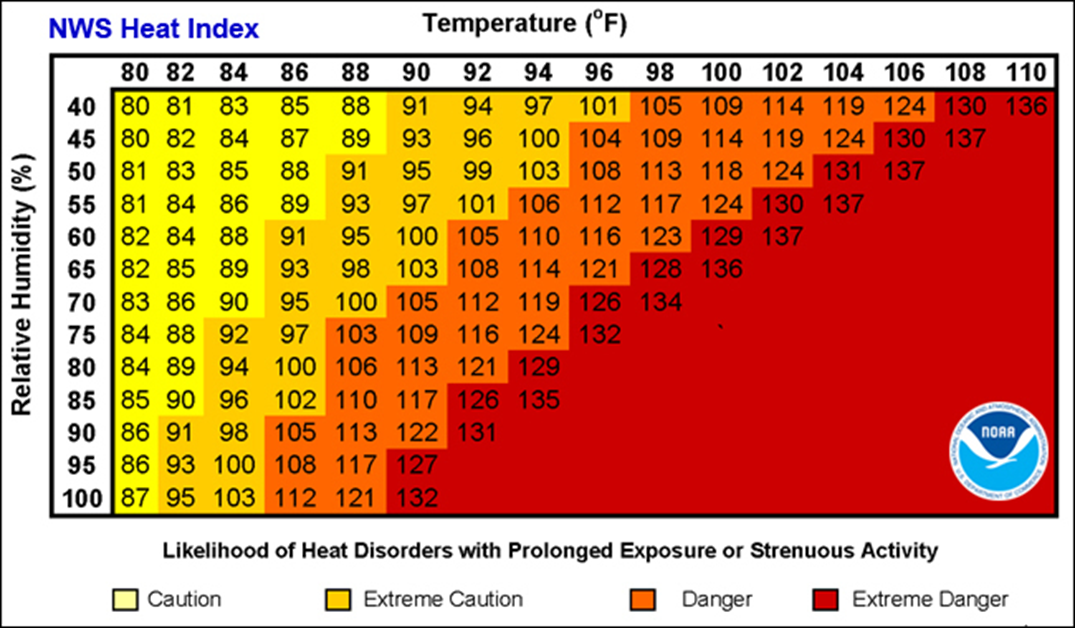
9.11 Appendix B — Description of Serious Heat-related Illnesses and Common Symptoms
|
Illness Types |
Symptoms and Signs |
|
Heat stroke |
• Confusion • Slurred speech • Unconsciousness • Seizures • Heavy sweating or hot, dry skin • Very high body temperature • Rapid heart rate |
|
Heat exhaustion |
• Fatigue • Irritability • Thirst • Nausea or vomiting • Dizziness or lightheadedness • Heavy sweating • Elevated body temperature or fast heart rate |
|
Heat cramps |
• Muscle spasms or pain • Usually in legs, arms, or trunk |
|
Heat syncope |
• Fainting • Dizziness |
|
Heat rash |
• Clusters of red bumps on skin • Often appears on neck, upper chest, and skin folds |
|
Rhabdomyolysis (muscle breakdown) |
• Muscle pain • Dark urine or reduced urine output • Weakness |
|
Acute kidney injury (AKI) |
• Kidneys become damaged due to inadequate blood flow or a second mechanism is rhabdomyolysis of kidney muscle tissue. • Diagnosed by elevated blood creatinine levels. Urine output is also reduced. • May lead to kidney failure |
Section 10: Separations
10.1 Separation
Prior to an employee's departure, an exit interview may be scheduled, face-to-face or over the phone, to discuss the reasons for separation and the effect of the separation on benefits. Also covered during the interview will be the process for returning all keys and any equipment; the verification of final pay and reimbursements and the payout of any applicable accrued leave. Employees will not be paid for unused sick leave, personal, or holiday leave time.
10.2 Resignation
The Library requests at least two (2) weeks written resignation notice from all employees be given and served. Supervisory employees are expected to give and serve at least a one (1) month notice.
Upon termination of employment, employees will be paid for unused vacation leave and compensatory time that has been earned through the last day of work up to the maximum accrual, provided that the employee provides sufficient notice as described in Section 8, Separations
Employees will not be paid for accrued, unused vacation time if proper notice is not given and served. In all cases, additional notice is appreciated.
10.3 Termination
Termination is the involuntary separation of an employee from the Library by the Board as the last step in the progressive corrective action process or due to extreme inappropriate behavior exhibited by the employee.
Probationary employees may be dismissed with or without cause by the Director. After an initial probationary period, an employee may be dismissed only for cause or for budgetary/ operational reasons. Behavior that constitutes grounds for immediate termination without severance pay includes, but is not limited to: misconduct in office, insubordination, incompetency, or willful neglect of duty.
Before removing a non-probationary employee, the Director shall send the employee a written copy of the charges and give the employee an opportunity to request a hearing before the board within 10 working days. The employee will have an opportunity to be heard publicly before the Board in their own defense, in person or by counsel and to bring witnesses to the hearing.
If the Board votes to terminate the non-probationary employee and the decision is unanimous, the decision of the Board is final.
If the Board votes to remove the non-probationary employee and the decision is not unanimous, the employee may appeal to the Maryland State Library Agency through the State Librarian.
10.4 Absent Without Leave (AWOL)
If an employee fails to report to work on a scheduled workday and fails to contact their supervisor within three (3) consecutive days, they will be considered to have quit. The employee will be notified by mail.
The Director may reinstate the employee if they can provide a valid reason or prove that extenuating circumstances prevented them from communicating with their supervisor.
10.5 Reduction in Force (Layoff)
A reduction in force is any involuntary termination of service to the Library taken by the Board of Trustees which is not based on employee performance.
Employees affected by a reduction in force will be given as much notice as possible by the Director, but no less than two weeks.
Employees will be placed on a re-employment list for the position they occupied at the time of separation. Those on the re-employment list will be given preference over other applicants for a period of two years should an appropriate vacancy occur, provided those on the list have kept their address current. Employees who have not applied for an offered position will be deleted from the re-employment list.
10.6 Retirement
Retirement is a voluntary employment termination initiated by an employee who meets the age and length of service requirements. Please give as much notice as possible.
10.7 Death
Separation will become effective as of the date of the death of the employee. All compensation due will be paid to the estate or closest relative of the employee upon verification.
Section 11: Corrective Action
11.1 Suspension without Pay
The framework for this policy is based on the Maryland Education Statute 23-406 (d). The Director has the authority to suspend a Library employee without pay for a specified period of up to ten (10) working days. The Director must provide the suspended employee a written statement that specifies the reasons for the suspension. A copy of this statement will be put in their personnel file. Offenses may include, but not limited to, misconduct in the workplace, insubordination, incompetence, or willful neglect of duty.
The employee can respond to the charges in writing to the Director within ten (10) working days after receiving notice of the suspension. They may also request a hearing before the Board of Library Trustees within the same timeframe.
If an employee is suspended without pay and found not guilty of the reasons for the suspension, all pay benefits lost by reason of the suspension will be refunded.
11.2 Progressive Corrective Action
Somerset County Library’s progressive corrective policy is designed to guide a structured process to improve and prevent a recurrence of undesirable employee behaviors and performance issues.
Progressive corrective action means that, with respect to most corrective actions, these steps
will normally be followed:
1. Counseling: This step creates an opportunity for the immediate supervisor to bring attention to the existing performance, conduct or attendance issue. The supervisor should discuss with the employee the nature of the problem or the deviation from established policies and procedures. The supervisor is expected to clearly describe expectations and steps the employee must take to align his or her performance with organizational expectations.
2. Verbal Correction: This step creates an opportunity for the immediate supervisor to again bring attention to specific instances of the existing performance, conduct or attendance issue. The supervisor should again discuss with the employee the nature of the problem or the deviation from established policies and procedures. The supervisor is expected to clearly describe expectations and steps the employee must take to improve his or her performance or resolve the problem.
3. Written Correction: This step involves more formal documentation of the performance, conduct or attendance issues. During this step, the immediate supervisor and their supervisor will meet with the employee to review any additional incidents or information about the performance, conduct or attendance issues as well as any prior relevant corrective action plans.
A formal performance improvement plan (PIP) requiring the employees’ immediate and
sustained corrective action will be issued in conjunction with the written correction.
4. Final written correction: In cases of continuing performance, conduct or attendance issues, the Library will issue a final written correction, again documenting specific instances and prescribing behaviors requiring immediate correction, before proceeding to a recommendation for suspension, demotion, or termination.
5. Suspension (with or without pay), demotion, or termination of employment: If performance continues to fail to improve after multiple attempts at correction, or when a serious infraction warrants such, the Library will rectify the situation following policy related to suspension (11.1), demotion (3.6), or termination (10.3), and provide the employee written notice of such.
The Library reserves the right to combine or skip steps depending on the facts of each situation and the nature of the offense. Some of the factors that will be considered are whether the offense is repeated despite coaching, counseling or training; the employee’s work record; and the impact the conduct and performance issues have on the organization.
The Library recognizes that there are certain types of employee problems that are serious enough (e.g. stealing, intoxication in the workplace, destruction of property, insubordination, workplace violence, sexual or other harassment, etc.) to justify either a suspension, demotion, or termination of employment, without going through the usual progressive corrective action steps.
By using progressive corrective action, we hope that most employee problems can be corrected at an early stage, benefiting both the employee and the Library.
Documentation:
The employee will be provided with copies of progressive discipline documentation, including all performance improvement plans. The employee will be asked to sign copies of this documentation attesting to their receipt and understanding of the corrective action outlined in these documents. Copies of these documents will be placed in the employee’s official personnel file.
Section 12: Grievance Procedures
12.1 Grievance Procedure
Not every problem can be resolved to everyone’s total satisfaction, but only through understanding and discussion of mutual problems can employees and management develop confidence in each other. Employees may discontinue the procedure at any step. The presentation of any grievance is the right of any Library employee without fear of reprisal.
Any non-probationary employee may file a grievance when the employee is adversely affected by (1) the application of the provisions of this Handbook, (2) the actions of the supervisor, (3) alleged discrimination or unfair treatment or unsafe or unhealthy working conditions.
The failure to meet any of the time deadlines outlined shall be deemed a waiver of any further grievance procedures. The final decision shall be the decision at the highest step or level to which the grievance or appeal was made. Unless the Director determines otherwise, any corrective action that is the subject of a grievance shall ordinarily not be effective until a final decision.
If a situation occurs where an employee believes that a condition of employment or a decision affecting them is unjust or inequitable, they are encouraged to make use of the following steps.
- Present the problem to the immediate supervisor within 10 days after the incident occurs. If the grievance is regarding the supervisor, then the employee may present the grievanceto the Director or designee. If the grievance is regarding the Director, then the employee may present the problem to the Board of Trustees.
- The supervisor will, within 14 days, respond to the problem during discussion or after consulting with appropriate management. The supervisor will document the discussion and inform the Director. The supervisor will reply in writing within 7 days. If the employee receives no response from the supervisor, the employee should treat the request for any remedial action as denied or unresolved.
- If the problem is denied or unresolved, the issue may be brought before the Director. Any appeal to the Director must be filed within 5 days of any action or inaction by the supervision in the previous step. This writing must contain at a minimum relevant facts and dates and specifics of the act and harm done and the remedy or adjustment requested. The Director will review and consider the problem and then inform you of the decision and forward copy of the written response for your file. The Director has full authority to make any adjustment deemed appropriate to resolve the problem.
- If the problem remains denied or unresolved, the issue may be brought before the Board of Trustees. Any appeal to the Board must be filed within 5 days of any action or inaction by the Director in the previous step. The decision of the Board will be final.
A grievance may not be filed when it involves a probationary employee as grievant, policy decisions by the Library, or counseling, documented warnings not filed in the employee’s personnel file, personnel appraisals with an overall rating of satisfactory or better, position classifications, separation due to reduction in workforce and the contents of this Handbook.
In the case of termination of a probationary employee, these grievance procedures shall not apply. Rather the provisions of this Handbook at 8.2 shall apply.
12.2 Violation of Grievance Procedure
An employee who takes their grievance outside of the Library without first attempting to resolve the problems in accordance to the procedure steps outlined above will be subject to corrective action.
Nothing in this section however abrogates any legal means of redress for discrimination, hostile work environment or any form of unlawful harassment through any governmental agency or the Courts.